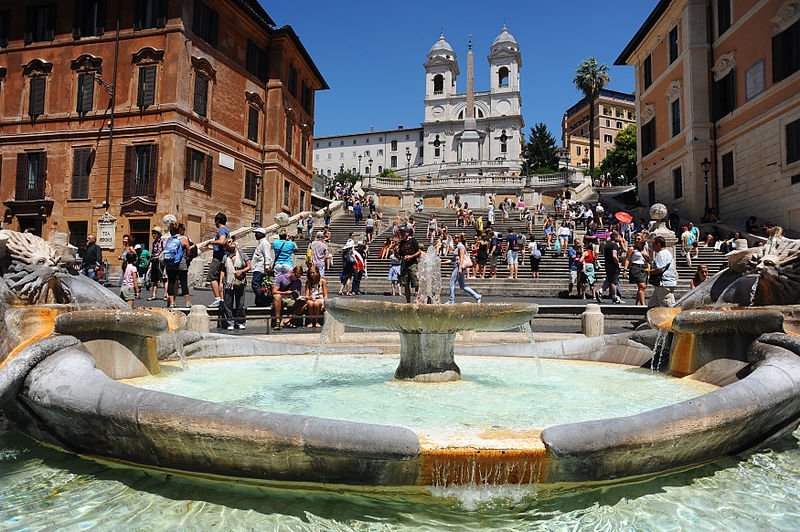
Piazza di Spagna is a 10-minute walk from our hotel in Rome's historic centre
Piazza Di Spagna
Location & Proximity
The 9Hotel Cesàri: Your Gateway to the Spanish Steps
Ideally located in Rome’s historic center, the 9Hotel Cesàri puts you just a 10-minute walk from the stunning Piazza di Spagna. When you stay at our boutique hotel, you’ll enjoy elegant and quiet rooms, perfect for recharging after a day of exploring. In the evening, our exclusive rooftop terrace, La Terrazza del Cesàri, invites you to enjoy a drink while taking in the rooftops of the Eternal City.
Our hotel’s immediate proximity to the square offers you the luxury of discovering it during its quietest hours, especially at sunrise when the marble catches the first rays of daylight. Our staff is on hand to point out the most picturesque side streets, ensuring you a memorable itinerary away from the crowds of tourists.
History
History of the Piazza di Spagna
The history of the Piazza di Spagna dates back primarily to the 17th century, when Pope Urban VIII Barberini ordered its development, notably by commissioning the construction of the famous fountain at the foot of the hill. Its unique name derives from the Spanish Palace, the building that housed the Spanish embassy to the Holy See and which dominated the square until the late 19th century.
In the center stands the Barcaccia Fountain, sculpted in 1627 by Pietro Bernini and his son Gian Lorenzo Bernini, which takes the unique form of a sinking ship. This one-of-a-kind work has inspired many artists over the centuries, including the German poet Johann Wolfgang von Goethe. Overlooking the fountain, the Spanish Steps and its 135 steps were built in the 18th century with funding from the King of France to connect the square to the eponymous church located above. Fully restored in 1995, this staircase offers an unforgettable panoramic view of Rome and has become an iconic setting in international cinema.
From the 18th century through the 19th century, the square also became an essential gathering place for European poets, writers, and artists undertaking their “Grand Tour.” Drawn by the romantic atmosphere of the place, the greatest minds of the era would settle there for extended stays. At the right-hand corner of the steps stands the Keats-Shelley House, the residence where the famous English Romantic poet John Keats passed away in 1821; today it is a museum that preserves the legacy of that entire literary generation, including precious manuscripts by Percy Bysshe Shelley and Lord Byron.
This gathering of cosmopolitan intellectuals had a profound impact on the square’s identity. Artists would meet at the nearby Caffè Greco to debate and seek inspiration, making this neighborhood the true epicenter of European Romanticism in Rome. This community of poets and painters played a major role in forging the legend of the Spanish Steps as a sanctuary of art, elegance, and nostalgia—a unique atmosphere that can still be felt today as you stroll at the foot of the historic steps.
Architecture
The Spanish Steps, a Baroque masterpiece
Inaugurated by Pope Benedict XIII on the occasion of the Jubilee of 1725, the monumental staircase at the Spanish Steps features 135 steps arranged in a unique structure of successive terraces. Financed largely by a bequest from the French diplomat Étienne Gueffier, this project aimed to connect the Church of Trinità dei Monti—then under French protectorate—to the square below, creating a strong symbolic and urban link.
Designed by architects Francesco de Sanctis and Alessandro Specchi after decades of political debate between the French Court and the Papacy, the staircase features a late Baroque style characterized by its curved lines and theatrical perspectives. Every spring, the railings are adorned with thousands of azaleas, continuing a colorful tradition that highlights the structure’s complex geometry. At the top, the Sallustian Obelisk towers over the ensemble, serving as a major visual landmark in the Roman landscape.
Culture & Surroundings
What’s there to see around the Piazza di Spagna?
The Piazza di Spagna are more than just their famous staircase; they’re surrounded by architectural masterpieces and monuments steeped in history. Just a short walk away, you can explore the prestigious Villa Medici, built in the 1570s, which has been home to the French Academy since 1803 and opens its magnificent gardens and exhibitions to the public.
Not far from there, you’ll also find Piazza del Popolo (People’s Square), a majestic space designed by architect Giuseppe Valadier in the late 18th century to provide the city with a breath of fresh air. Valadier harmoniously integrated key historical elements into the design: the central obelisk, the Porta del Popolo, and the two twin churches that mark the entrance to Via del Corso. It’s an ideal area for long cultural strolls.
Shopping
A Destination for Luxury Shopping
Today, the Piazza di Spagna stands as the undisputed mecca of haute couture and luxury shopping in Rome. The adjacent streets are home to the most prestigious Italian and international fashion houses, transforming the neighborhood into a veritable open-air fashion show for lovers of trends and sophistication.
Via Condotti, the most famous thoroughfare leading directly to the square, is lined with sumptuous storefronts, renowned jewelers, and designer boutiques such as Valentino, Prada, and Gucci. While the prices reflect the exceptionally high quality of the products, the atmosphere becomes particularly lively during sales periods, offering visitors an exclusive shopping experience in the heart of Roman elegance.
Frequently Asked Questions
Everything You Need to Know Before You Go
How far is the 9Hotel Cesàri from the Piazza di Spagna?
The 9Hotel Cesàri is located just 750 meters from the Piazza di Spagna. Simply walk up Via del Corso and then turn onto Via Condotti to get there in about 8 to 10 minutes on foot.Why is the square called Piazza di Spagna?
It takes its name from the historic presence of the Spanish Embassy to the Holy See, which has been located in the Palazzo di Spagna on the square since the 17th century.Can you sit on the steps of the Pizza di Spagna?
To preserve this UNESCO World Heritage Site, strict municipal regulations now prohibit sitting, eating, or drinking on the steps of the Trinità dei Monti staircase. You may, however, walk up the steps to enjoy the view.What is the name of the fountain located in the Piazza di Spagna?
It is the Barcaccia Fountain (Fontana della Barcaccia), a Baroque work sculpted by Pietro and Gian Lorenzo Bernini depicting a half-submerged boat.