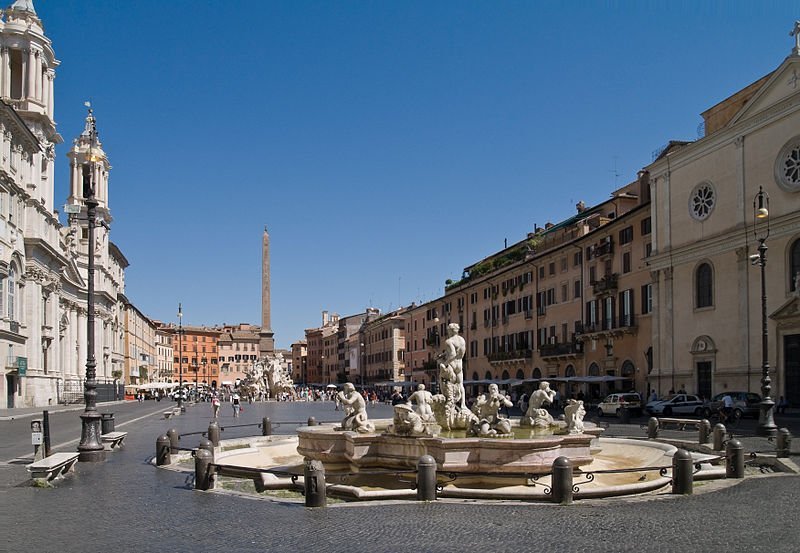
9Hotel Cesàri is a very short walk from Piazza Navona
Piazza Navona
Location & Comfort
The 9Hotel Cesàri: Your Ideal Hotel Near Piazza Navona
Ideally located in the historic heart of Rome, the 9Hotel Cesàri offers you exclusive access to Piazza Navona, just a few minutes’ walk away. When you stay at our boutique hotel, you’ll enjoy the perfect base for alternating between exploring the square’s Baroque masterpieces and moments of complete relaxation in the elegant comfort of your room.
Piazza Navona is located along the ideal route if you plan to walk to the Vatican from the 9Hotel Cesàri, making it an unmissable cultural stop. Our boutique hotel has thought of every detail of your stay to offer you a first-class experience: after strolling along Rome’s cobblestone streets, you can relax in the cozy atmosphere of our rooms or order a signature cocktail on our rooftop terrace, La Terrazza del Cesàri. Our attentive staff is at your service to guide you and share their best tips to make your stay unforgettable.
Architecture & Origins
The History of Piazza Navona and Its Ancient Origins
Piazza Navona is one of Rome’s most famous and monumental squares, attracting millions of visitors each year who come to admire its exceptional heritage. Its fascinating history begins in the 1st century AD, when Emperor Domitian had a massive stadium built there, dedicated to athletic competitions, games, and chariot races.
After the fall of the Roman Empire, this ancient stadium—which could seat up to 30,000 spectators—was gradually abandoned, but its structure was never demolished. In the Middle Ages, the Romans began building houses and churches directly on top of the ancient travertine stands, thus perfectly preserving the oval shape of the original arena, which for a time served as a marketplace and a venue for equestrian games.
The true transformation into a Baroque gem took place in the 17th century under the leadership of Pope Innocent X, a member of the powerful Pamphili family whose palace bordered the square. Eager to celebrate his glory, he entrusted the greatest geniuses of the era—such as Bernini and Borromini—with the task of completely redesigning the space. The tarring of the ancient track gave way to a monumental complex measuring approximately 240 meters long by 65 meters wide, transforming the former arena into an architectural masterpiece unlike any other in the world.
Art & Sculptures
The Three Baroque Fountains of the Square
Piazza Navona owes much of its worldwide fame to the three majestic fountains that adorn it, true artistic masterpieces of the Baroque era. The most famous of these is undoubtedly the Fountain of the Four Rivers (Fontana dei Quattro Fiumi), sculpted in 1651 by the master Gian Lorenzo Bernini (Bernini) in front of the Church of Sant’Agnese.
This masterful work is crowned by an Egyptian obelisk brought to Rome during the reign of Emperor Domitian. Each monumental statue on the fountain personifies one of the four great rivers representing the continents known at the time: the Nile for Africa, the Río de la Plata for the Americas, the Ganges for Asia, and the Danube for Europe. At the far ends of the square stand two other fountains originally designed by Giacomo della Porta in the 16th century: the Fountain of the Moor to the south, depicting a Moor battling a dolphin, and the Fountain of Neptune to the north, where the Roman god of the sea is surrounded by sea creatures, tritons, and dolphins.
Religious Heritage
The Church of Sant'Agnese in Agone
A central feature of the square’s landscape, the Church of Sant’Agnese in Agone is one of Rome’s most spectacular Baroque religious buildings. Construction began in 1652 under the direction of the eminent architect Francesco Borromini, on the exact spot where the young Saint Agnes is said to have been martyred in the 3rd century.
After several interruptions and disputes with the original patron (Pope Innocent X), the building was completed in 1672 by Carlo Rainaldi. The exterior is distinguished by its unique concave façade, imposing columns, and triangular pediment bearing the Pamphili family coat of arms. Inside, the sight is magnificent: the walls and ceilings are covered with masterful frescoes that create a striking illusion of depth. The main altar features a large marble and bronze altarpiece depicting the saint surrounded by angels, while the Chapel of the Virgin houses a precious relic of Saint Agnes as well as a Byzantine icon considered miraculous.
Festivities & Seasons
A lively square all year round
Piazza Navona comes alive with the changing seasons and remains a vibrant, festive gathering place at any time of year. In winter, it transforms to host the famous Christmas market (Mercatino di Natale), featuring traditional decorations, handmade gifts, and local culinary specialties, culminating on January 6 with the traditional Epiphany procession.
As the months go by, the atmosphere is constantly changing:
- Carnival: The square comes alive with musical performances, street theater, and dances in traditional costumes.
- Spring: This is the perfect season to enjoy outdoor concerts—from jazz to classical music—under the Roman sun.
- Summer: Street performers, painters, jugglers, and musicians take over the square to the delight of passersby, alongside outdoor film screenings.
- Fall: Gastronomy takes center stage with local food festivals and wine tastings, complemented by intimate concerts in the surrounding historic churches.
Tourism & Lifestyle
Terraces, restaurants, and nearby landmarks
Beyond its inherent beauty, Piazza Navona stands out for its welcoming atmosphere and its close proximity to Rome’s most famous landmarks. Located just a few steps from the Pantheon and within walking distance of the Trevi Fountain and the Pizza di Spagna, it serves as the perfect hub for exploring the city’s historic center.
To fully immerse yourself in the Italian way of life, take the time to settle into one of the many café or restaurant terraces lining the oval square. From cozy traditional pizzerias to fine-dining restaurants and typical open-air cafés, you can enjoy an authentic espresso or a traditional Roman dish while watching the hustle and bustle of passersby and the sun’s reflections on the marble of the fountains.
Frequently Asked Questions
Everything you need to know before you go
How far is the 9Hotel Cesàri from Piazza Navona?
The hotel is located right next to the square. You can reach it in less than 10 minutes on foot through the charming alleys of Rome’s historic center.What is the main fountain in Piazza Navona?
The central and most famous fountain is the Fountain of the Four Rivers (Fontana dei Quattro Fiumi), designed by the artist Gian Lorenzo Bernini in the 17th century.What other monuments are worth visiting near the square?
Piazza Navona is just a few minutes’ walk from the Pantheon, Palazzo Altemps, Campo de’ Fiori, and the Church of St. Louis of the French.How far is the Colosseum from Piazza Navona?
The Colosseum is about 2 kilometers from Piazza Navona. It takes about 20 minutes to walk there along the famous Via dei Fori Imperiali, a pleasant route that takes you past the ancient forums.How far is the Trevi Fountain from Piazza Navona?
The Trevi Fountain is located just 1 kilometer from the square. You can easily walk from one monument to the other in less than 15 minutes through the pedestrian streets of Rome’s historic center.