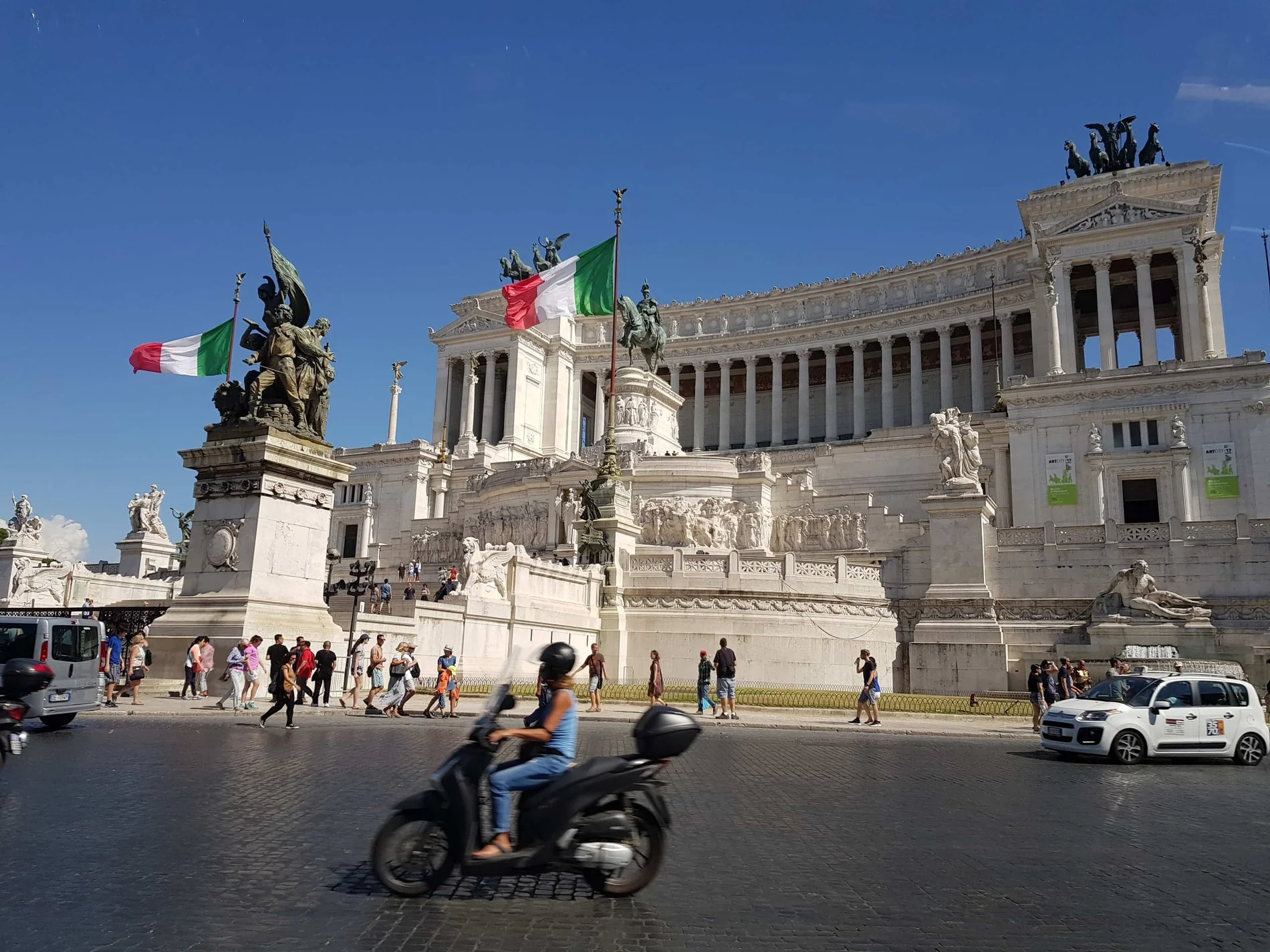
Piazza Venezia, near our hotel in Rome, is a sightseeing must during your visit to the capital
Piazza Venezia
Location & Proximity
The 9Hotel Cesàri is ideal for exploring Piazza Venezia
Boasting an exceptional location right in the heart of the historic center, the 9Hotel Cesàri is just a 5-minute walk from the famous Piazza Venezia. Staying at our boutique hotel gives you the privilege of reaching this central hub of Rome in an instant, making it very easy to plan your visits, whether you decide to explore ancient Rome or the Baroque alleyways.
Piazza Venezia serves as the perfect starting point for exploring the entire capital during your stay at the 9Hotel Cesàri. After a busy day spent admiring the grandeur of Rome’s monuments, you’ll appreciate returning to the refined tranquility of our historic hotel, relaxing in the peace and quiet of our rooms, or heading up to our rooftop terrace, La Terrazza del Cesàri, to enjoy a drink at sunset. Our staff will be happy to recommend the most beautiful walking routes connecting the hotel to the square.
History & Architecture
The Origins of Piazza Venezia and Palazzo Venezia
Piazza Venezia takes its name from the majestic Palazzo Venezia, a masterpiece of Renaissance architecture that lines the west side of the square. Built between 1455 and 1467 by Cardinal Pietro Barbo (the future Pope Paul II), this imposing building first served as a papal residence before becoming the seat of the Republic of Venice’s embassy to the Holy See.
Over the centuries, the palace entered modern history by becoming the headquarters of the Fascist government in the early 20th century. It was from its famous central balcony that Benito Mussolini delivered his speeches to the crowds gathered in the square. Today, the building has returned to a peaceful and cultural purpose: it houses the National Museum of the Palazzo Venezia, which features rich collections of paintings, sculptures, ceramics, and antique weapons, as well as the prestigious library of archaeology and art history.
National Monument
The Vittoriano, a monument celebrating a united Italy
The most spectacular and unmissable feature of the square is the Monument to Victor Emmanuel II, also known as the Vittoriano or the Altar of the Fatherland (Altare della Patria). This colossal structure, carved from white Botticino marble, was erected between 1885 and 1911 to celebrate the unification of Italy and pay tribute to the first king of a united Italy, Victor Emmanuel II, whose bronze equestrian statue stands proudly at its center.
Designed by architect Giuseppe Sacconi, the monument stands out for its grandiose neoclassical architecture, punctuated by an immense Corinthian colonnade and countless allegorical sculptures. Often ironically nicknamed “the typewriter” or “the wedding cake” by Romans because of its imposing size and dazzling whiteness, which contrasts sharply with the city’s ochre tones, the Vittoriano also houses the Tomb of the Unknown Soldier, guarded day and night by an honor guard, as well as the Central Museum of the Risorgimento.
Unique Panorama
An exceptional panoramic view of the Eternal City
Beyond its rich history, the Vittoriano offers one of Rome’s most beautiful viewpoints thanks to its perfectly oriented terraces. As visitors climb the grand marble staircase, they first reach an observation level offering a breathtaking view of the bustling square and the surrounding palaces, such as the Bonaparte Palace, where Napoleon’s mother once lived.
For an even more spectacular experience, you can take the panoramic glass elevator (“Roma dal Cielo”) located at the rear of the monument. It takes you to the top of the Quadrige Terrace, which rises to a height of about 80 meters. From up there, a magnificent 360-degree panorama unfolds before you: you can admire the details of the Roman Forum just below, the silhouette of the Colosseum, the domes of the Baroque churches, and, on the horizon, the dome of St. Peter’s Basilica. A must-see for photography enthusiasts.
Art & Renaissance
The Square’s Hidden Gems and the Twin Churches
While the Vittoriano commands everyone’s attention, Piazza Venezia is home to other artistic and architectural treasures that deserve special attention. Right next to the monument stands the Basilica of San Marco Evangelista, a very old church integrated into the structure of the Palazzo Venezia, whose interior features sumptuous 9th-century Byzantine mosaics and a magnificent Renaissance coffered ceiling.
If you look further toward the beginning of Via dei Fori Imperiali, you’ll also discover two twin Baroque-era churches: the Church of Santa Maria di Loreto and the Church of the Santissimo Nome di Maria at Trajan’s Forum. These elegant buildings, constructed side by side, mark the perfect transition between the modern square and the archaeological area of the forums, offering a stunning contrast of domes and architectural lines against the setting sun.
Frequently Asked Questions
Everything you need to know before you go
How far is the 9Hotel Cesàri from Piazza Venezia?
The 9Hotel Cesàri is located just 400 meters from Piazza Venezia, a mere 5-minute walk down Via del Corso.What is the name of the large white monument located in the square?
This monument is the Vittoriano (or Altar of the Fatherland), a monumental white marble structure built in honor of King Victor Emmanuel II and the unification of Italy.Can you go to the top of the monument in Piazza Venezia?
Yes, access to the lower terraces of the Vittoriano is completely free. However, there is an admission fee to access the upper terrace of the Quadriges via the panoramic glass elevator.What is housed in the Palazzo Venezia today?
The palace is home to the National Museum of the Palazzo Venezia, which houses important collections of applied art, Renaissance paintings, and sculptures, as well as a large art history library.